General Gear & Items
Breaking Down Items
Items may be broken down to their base materials.
The materials from gear may be broken down. The material resources returned are equal to the amount required in their creation, & at the same tier level. Meaning an extra-large creature’s T5 weapon will break down into nine (9) T5 metal ingots, instead of the normal one (1) T5 ingot from a medium sized creature’s weapon.
The same is true for cloth, wood, & many other custom materials used in crafting.
This task requires a toolkit & at least a skill of one (1) in any skill that normally works with those materials. This may be done as 1 “daily task” per item being broken down this way.
Size Does Matter
A creature may not use the gear from another size category. Not even the tools. A warhog’s hammer & chisel is too big for a neo-tabby to use, & a neo-tabby’s tools are much too small to be wieldy for any larger creature. (Although, it might make sense for a GM to allow a creature to use a cloak from a larger creature in a fashion similar to a bedroll.)
Armor Must be Fitted
Worn gear, such as armor & clothing, would need to be fitted by a character that has a skill level equal to that item’s tier value or higher. Usually weapons & shields are more universal, with only some races causing them to need modification. But armor is fitted, & would need to be refit for your character to use regardless. Work with your GM. They may be more or less flexible with some things for your character.
Wear, Equip, & Carry
“Worn” includes worn & equipped items, including armor. “Equipped” includes armor & weapons held in hand. “Carried” includes all items worn, equipped & any non-weapons held in hands.
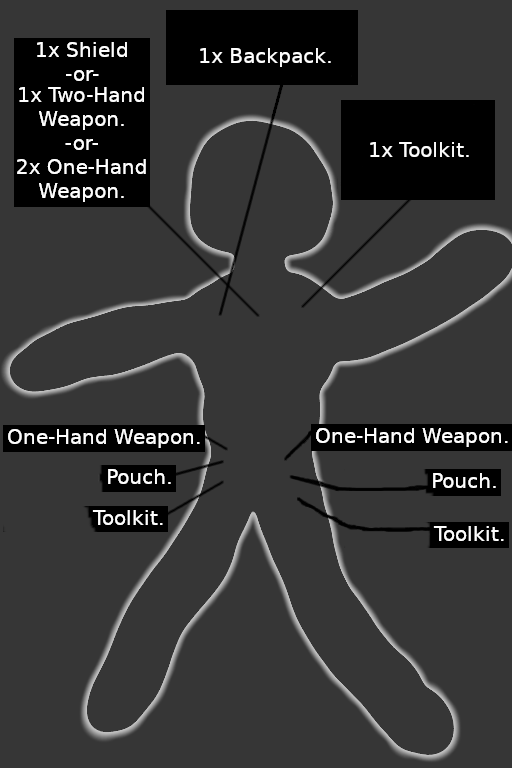
Each character has several available slots for carrying items:
• Right hip [1h-weapon], Right hip [Toolkit], & Right hip [misc or ammo]
• Left hip [1h-weapon], Left hip [Toolkit], & Left hip [misc or ammo]
• Back [2h-weapon -or- 1h-weapon x2 -or- shield], Back [Toolkit], & Back [misc or ammo]
Each character may have 1 item assigned to each slot listed. Only items listed in weapon slots may be drawn in combat & may be swapped between at any time. Only ammunition stored in a “[Item specific] container” worn in a carry slot may be retrieved without an action penalty (or add 1 additional non-contested action to retrieve it). Each weapon’s Tier value worn in these slots must be at a level that is equippable by the character (you cannot carry a T12 1h-melee with only Body: 6).
For example: a character may have a sword, a toolkit, & arrow quiver (as [Item Specific] Pouch) on their right hip -and- a 1h-crossbow, a toolkit, & a bolt pouch (as [Item Specific] Pouch) on their left hip -and- a bow, toolkit, & misc-pack (as Backpack) on their back.
*Characters may also be allowed to travel with items carried (or equipped) in their hands in addition to their carry slots if allowed by GM, on a case by case basis.
*Characters cannot wield weapons or shields while actively working on any task(skill) that requires tools.
Weapons can be stored as loose inventory in backpacks or carts (their size categories are listed right below), but cannot be quickly equipped from anywhere other than their designated worn quick-draw slot. Since weapons being stored this way is not strictly bound to any specific size (only rough categories), & because weapons can vary greatly in size in real life, work with your GM to determine the exact size of your stored weapons or use the highest amount of spaces listed for it’s category.
Item Size Categories
Items will be generally categorized as follows:
• Extra-Small (XS): up to 10 may be stacked in 1 inventory space
• Small (S): takes up 1 inventory space
• Medium (M): takes up to 10 inventory spaces
• Large (L): takes up to 100 inventory spaces
• Extra-Large (XL): takes up to 1,000 inventory spaces
(XS) items include coins, 1hr candles, pens, paper, ores, cloth fragments, gems, jewelry, feathers, seeds, healing baubles, & most other very small objects that a person could hold several of in the palm of their hand.
(S) items include ingots, cloth, 1 day of food, vial of ink, arrows, crossbow bolts, & most small objects that don’t make sense to stack.
(M) items include books, some pouches designed for carrying on a hip, clothing sets, Lamps, torches, tinderboxes, lumber, rope (10ft), cloaks, 1-Handed weapons, & many other objects that generally use about the same space as a human skull.
(L) items include most backpacks, most toolkits, stone blocks, 2-Handed Melee weapons, shields, bows, 2-Handed crossbows, tents, bedrolls, armor sets, & most other objects between the size of a human skull & a human skeleton.
(XL) items include wood beams, Chests, people, & most things larger than a human & smaller than a wagon.