Basic Rules

  • Beginner’s Guide

    Creation of a balanced party is key to success. Whenever possible, the group should work together at character creation. Overlapping skills rarely have much use if the group finds themselves reliant on each other for survival. By default, the character with the highest level in any skill will likely be the only one performing that task. Meanwhile the other character would likely be delegated to other work with their limited “Daily Tasks” they have available.

    Picking races can be very impactful on how the character will be played. Large races have higher daily food requirements & equipment costs, but will dominate in battle. For first time groups, it is probably best practice to choose from the medium races. But having 1-2 small characters will offset the food needs of some large races. Extra Large races require much more coordination, & depending on the environment you are dropped into, could become a liability to the group quite quickly.

    Advice on Stats

    This game has no dump stats. While bullet pointing a character will make them much more effective in a role, it will leave gaps in their defenses tactically. Taking a zero in a stat is legal, but highly unadvised.

    • A zero in Body would limit daily travel for the whole group, lock a character at 20HP, disallow cloaks, armor & shields, & would limit weapons to only Unarmed, crossbows, & firearms.
    • A zero in Mind would disallow all skill points, & would lock a character at 20MP.
    • A zero in Reflex would have much lower chances of success in dealing damage in combat, & much higher chances of receiving damage when attacked.
    • A zero in Presence would get back-stabbed constantly in battle, & would get wrecked by traps.

    If you coordinate as a group, you can easily get away with having a couple characters that compliment each other by filling in gaps to allow bullet-pointing. But if the tank decides to frell off to Narnia – that squishy, low armor, low Reflex, high Presence, high stealth, bow user is going to get rocked.

    Advice on Skills

    Some skills won’t help you much in the wilderness. You’re group isn’t likely to stay in town forever (assuming your GM even starts you near a town). Highly important skills for a group of adventurers get lost in the large list of skills available to take. If survival is key, then these are good starting skills for a group to spread out. Remember the “Daily Task” limit is 2 each day. So you would be doing a disservice to your group if you try to lump them all onto one character.

    • Bushcraft – All the things you need to survive, even if you have nothing. I would recommend having a skill level at least as high as the number of characters in your group.
    • Woodworks, Metalworks, & Tailor – These skills can craft several objects & are prerequisite skills for more advanced crafting skills. It is important that a group has at least a 1 in each of these skills for repairs & material recycling. Remember that you need a high level in Metalworks to create high Tier crafting materials. Wood is simpler, as it has no Tier values. Cloth adopts the Tier value assigned at their creation by a Tailor. Each Tier requires higher Tailor levels & slightly more Cloth Fragments to create.
    • Mining, & Logging – Logging, & Mining allow gathering of wood & ores with zero skill. However, the rates are drastically faster with more skill points assigned. If you don’t want to slowly gather Beams & Ores, you can assign a few points to these skills, or you can just recycle loot.
    • Cooking – Food expires very quickly. Unless you want your group to be permanently living a “hand to mouth” lifestyle, they will need this skill at 1 or higher. Eos has long winters. Narratively, most of the food sources will be harder to obtain for several months each year. If your food expired after a week, you won’t survive another 3 months of snow unless you get incredibly clever or lucky. While Bushcraft can gather food as part of their tasks, even in snow, it would be an uphill battle. Especially once the Environmental damage from the cold exceeds their clothing bonuses & they start taking damage for each hour they are exposed.
    • Farming, Hunting, Traps, Bushcraft, & Fishing – Each of these skills will help gather food. Each has their own benefits to a group. Even if a character in the group has a high Bushcraft skill, it would be greatly beneficial for any group to have at least one of the other food gathering skills. Farming takes a month to produce anything. It’s good, but requires group consensus to remain locked in one zone.
    • Armorsmith – Looted armor must be fitted. The required skill level to refit armor to another character is equal to the Tier value of the armor. Additionally, the Armorsmith can create new armor once they have the time, tools, & resources.
    • Bowyer, Weaponsmith, & Crossbow Smith – These skills allow you to make decent weapons. You don’t need them all, but having at least one at a moderate level would be nice.

    Advice to Survive

    Worst case game loop. If your GM drops you in the middle of nowhere with no gear or supplies. This may be the start of the game, or a shipwreck late in a campaign, or a banishment from a kingdom after arrest. However you got to this point, we want to make the best of our time to survive.

    • Find or create shelter – It halves damage from the elements. If it gets cold overnight, your characters will start their day with less HP. If it is cold enough, they’ll just die.
    • Fire – if used with shelter, it will negate all cold damage while inside. More critical in colder environments or seasons. If it’s warm, fire can go lower on the list, but you’ll still need it from time to time.
    • Secure food – Several skills can gather food. Many of them require tools to do so.
    • Craft Crude Toolkits – A spear for your hunter, a trap toolkit for your trapper, a net for your fisher. The Bushcraft-skilled survivor in your group must work overtime. After food is more secure, they will spend more time crafting some Toolkits for the characters that can gather resources or craft items.
    • Cloaks – Cloaks can be made by a character with Bushcraft. If you have a hunter or trapper, they can gather cloth fragments fairly quickly. If you have a Tailor, they can craft Tier 1+ Clothing, which has no Body stat requirement. Make enough coverings for the characters to survive & preferably be able to work outside without taking too much damage.
    • Find a mine – These ores will be used to craft Basic Toolkits, weapons & armor.
    • Craft Basic Toolkits – Basic Toolkits require at least level 2 in Metalworks. These tools drastically cut down the time needed to craft items. Gathering skills get huge bonuses from better tools. Basic tools take a while to craft, so set up a priority order for the environment your in.
    • Craft gear – Balance your time. Starting with a bunch of Tier 2-4 gear will greatly swing battle, & not cost months to produce. After everyone is initially geared, start churning better gear in the background for each character.
    • Craft containers – If you want to be on the move, high level backpacks & pouches will allow you to keep enough on you to survive & travel. If anyone uses projectile weapons (bow, crossbow), it would be good to get them a pouch for ammunition so they don’t have to waste actions pulling them from their backpack.
    • Settle in or get moving – Use Woodworks to craft more permanent structures… Establish Farming… Build Workshops… let time slide by as your character ages in the vast wilderness or desert isle. Or, high tail it out of there. Vehicles are useful. The “Skids” from Bushcraft are better than nothing. Much of the finishing touches to gear can be made while traveling. Besides. There’s interesting things to do out there.
  • Skills & Progression

    Skill Points

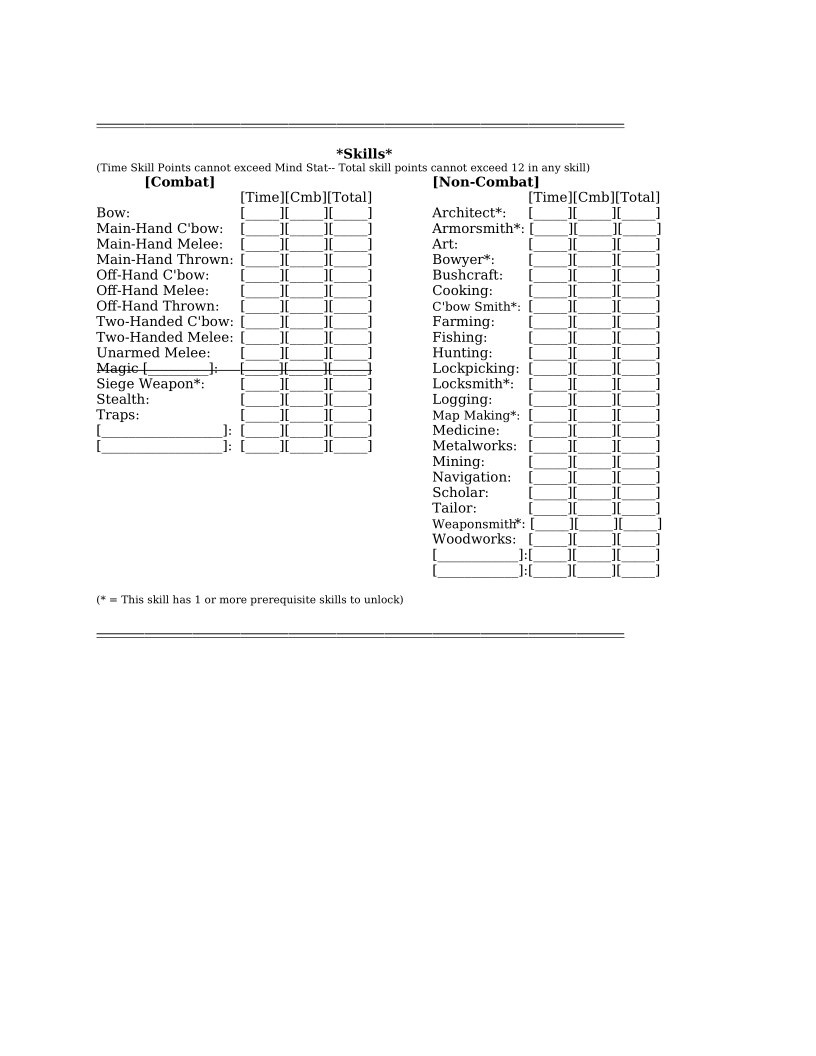
    Skill points are used as dice modifiers, similar to Reflex or Presence, for many combat & non-combat rolls. Skill points are used to gather resources more efficiently. Skill points are used as thresholds for crafting items into higher tiers. Skill points are just as important for building a character as their stats are.

    Skill point distribution can be recalculated each combat level. Juggle them around & make the math work. The math should work the same forward as it does backward for skills. Just try to keep the skills your swapping around have the same total level or higher when you’re done.

    Example: If you have “Tailor: 5(time)+2(combat)=7(total)” — You have “Tailor: 7”. If you gain a combat level & you raise your Mind stat from 5 to 6, you may replace a combat skill point with a passive skill point to have “Tailor: 6(time)+1(combat)=7(total)” — You still have “Tailor: 7”. Now you can use that combat skill point somewhere else, or put it back into tailor to raise it to 8.

    *No skill may be a negative number.
    *Average level skills are 5-6 for a professional.
    *Levels 9-10 are usually reserved for the best in their field.
    *Levels 11-12 are legendary, & usually reserved for only player characters or “power NPC’s”.
    *Levels higher than 12 are restricted to only a few races.

    Passive Skill Points

    For each month that passes, a character gains 1 point (as a time skill point) to add to any skill up to that character’s Mind stat. If all skills are maxed, then these skills points will be able to be used when the character next raises their Mind stat.

    Combat Skill Points

    For each Combat Level, a character gains bonus skill points (as Cmb skill points) to add to any skill. The amount rewarded is based on their Mind stat. Skill levels should not exceed a total 12 at any time. Only Combat Skill Points may go above your Mind stat.

  • · ·

    Basic Item Shop

    All prices are listed in Iron Coins.

    DenominationValue in Iron
    Copper Coin0.10
    Iron Coin1
    Silver Coin10
    Gold Coin100
    Platinum Coin1,000
    Black Coin10,000

    Other common coins are listed in the “Denomination” table.

    All Costs in the Basic Item Shop are for Medium-sized creatures.

    The material cost of all gear including clothing, weapons, armor, tool kits, pouches, etc. will be tied to the creature’s general size category as:

    • A small race will need half (0.5x) the materials.
    • A medium race will need a normal amount (1x) of materials.
    • A large race will need four times (4x) the materials.
    • A extra-large race will need nine times (9x) the materials.

    General Resources

    Format: (size in inventory slots)[object]: [cost]

    (0.1)Metal Ore: 1(0.1)Cloth Fragment: 0.5(1)Fresh Food (per day): 1
    (1)T1 Metal Ingot: 10(1)T1 Full Cloth: 5
    (1)T2 Metal Ingot: 20(1)T2 Full Cloth: 10
    (1)T3 Metal Ingot: 30(1)T3 Full Cloth: 15
    (1)T4 Metal Ingot: 50 (1)T4 Full Cloth: 20(1)Preserved Food: 5
    (1)T5 Metal Ingot: 75(1)T5 Full Cloth: 25
    (1)T6 Metal Ingot: 100(1)T6 Full Cloth: 30
    (1)T7 Metal Ingot: 135(1)T7 Full Cloth: 35
    (1)T8 Metal Ingot: 170(1)T8 Full Cloth: 40
    (1)T9 Metal Ingot: 215(1)T9 Full Cloth: 45
    (1)T10 Metal Ingot: 260(1)T10 Full Cloth: 50

    More Resources

    (50)Stone Block (x4): 1 (100)Wood Beam: 1(10)Lumber: 1
    (1)Rope (per 10 feet): 1 (0.1)Feather (x1): 0.1(0.1)Paper (x1): 0.1
    (0.1)Pen: 10(1)Ink Pot (100pg): 10(5)Blank Book (100pg): 20

    Tailored Containers

    (overall size) [Tier value] (internal inventory): cost

    Generic
    Pouches
    [Item
    Specific*]
    Pouches
    Generic
    Backpacks
    [Item
    Specific*]
    Backpacks
    (3)T1 (2 slots): 10(4)T1 (3 slots): 10(5)T1 (4 slots): 10(6)T1 (5 slots): 10
    (5)T2 (4 slots): 20(7)T2 (6 slots): 20(9)T2 (8 slots): 20(11)T2 (10 slots): 20
    (7)T3 (6 slots): 40(10)T3 (9 slots): 40(13)T3 (12 slots): 40(16)T3 (15 slots): 40
    (9)T4 (8 slots): 60(13)T4 (12 slots): 60(17)T4 (16 slots): 60(21)T4 (20 slots): 60
    (11)T5 (10 slots): 90(16)T5 (15 slots): 90(21)T5 (20 slots): 90(26)T5 (25 slots): 90
    Generic
    Pouches
    [Item
    Specific*]
    Pouches
    Generic
    Backpacks
    [Item
    Specific*]
    Backpacks
    (13)T6 (12 slots): 120(19)T6 (18 slots): 120(25)T6 (24 slots): 120(31)T6 (30 slots): 120
    (15)T7 (14 slots): 160(22)T7 (21 slots): 160(29)T7 (28 slots): 160(36)T7 (35 slots): 160
    (17)T8 (16 slots): 200(25)T8 (24 slots): 200(33)T8 (32 slots): 200(41)T8 (40 slots): 200
    (19)T9 (18 slots): 250(28)T9 (27 slots): 250(37)T9 (36 slots): 250(46)T9 (45 slots): 250
    (21)T10 (20 slots): 300(31)T10 (30 slots): 300(41)T10 (40 slots): 300(51)T10 (50 slots): 300
    • *[Item specific] means that it can hold only 1 type of small or extra small object (like arrows, coins, units of food, ores, ingots, cloth fragments, full cloth, etc.)

    Clothing & Accessories

    ClothingBedrolls & TentsRandom Junk
    (10)T1 Clothing Set
    (+1 cold armor): 10
    (20)T1 Bedroll
    (+2 cold armor): 15
    (10)Bushcrafter’s Cloak
    (+1 cold armor): 1
    (10)T2 Clothing Set
    (+5 cold armor): 20
    (20)T2 Bedroll
    (+4 cold armor): 30
    (210)T2 Wooden Chest
    (200 slots): 20
    (10)T3 Clothing Set
    (+3 cold armor): 40
    (20)T3 Bedroll
    (+6 cold armor): 55
    (310)T2 Wooden Food
    Chest (300 units): 20
    (10)T4 Clothing Set
    (+4 cold armor): 60
    (20)T4 Bedroll
    (+8 cold armor): 80
    (1)Self-Grooming kit: 30
    (10)T5 Clothing Set
    (+5 cold armor): 90
    (20)T5 Bedroll
    (+10 cold armor): 115
    (1)T1 Lock
    (target#21): 15
    (10)T6 Clothing Set
    (+6 cold armor): 120
    (20)T6 Bedroll
    (+12 cold armor): 150
    (1)T5 Lock
    (target#25): 140
    (10)T7 Clothing Set
    (+7 cold armor): 160
    (20)T7 Bedroll
    (+14 cold armor): 195
    (1)T10 Lock
    (target#30): 510
    ClothingBedrolls & TentsRandom Junk
    (10)T8 Clothing Set
    (+8 cold armor): 200
    (10)T2 1-Person tent: 30(5)5-Hour Torch*: 1
    (10)T9 Clothing Set
    (+9 cold armor): 250
    (20)T2 2-Person Tent: 50(10)Hurricane Candle
    Lamp: 100
    (10)T10 Clothing Set
    (+10 cold armor): 300
    (30)T2 3-Person tent: 70(0.1)1-Hour Candle: 1
    (2)T10 Fancy Hat*: 300(40)T2 4-Person tent: 90(0.1)10HP Healing
    Bauble**: 100
    (1)T10 Sunglasses*: 1800(50)T2 5-Person tent: 110(XL)Basic Cart***: 100
    (0.1)T6 Gold Ring: 200(60)T2 6-Person tent: 130(5)T5 Book (fiction): 50
    • *A lit torch or candle will project a 5-tile radius of bright light and a secondary 10-tile radius of Low Light 1.
    • **Fancy Hat & Sunglasses have no bonuses associated with them. It’s just a display of excess money.
    • ***Healing Baubles instantly heals a character when they invoke the item. One time use only. A glass marble remains after use. May only be used for self healing. It cannot be invoked by a character to target characters other than themselves.
    • ****”Basic Cart” can carry 2 total, in any combination, of: Food Chest, Misc Chest, Resting PC/NPC – Or it may be used to hold up to 200 item slots worth of loose objects. 2×2 tile size – Not usable off of “trails” or “roads”. Requires Body: 4+ to move. A character pulling a basic cart cannot take double-movement actions or enter a run state. It is designed to be pulled by a medium sized race. Can be crafted for other size races – use general creature size rules for Cart’s associated item slots & tile size. GM call for carried people with sm, lg, & xl creature sized carts when carrying people with size categories not matching the cart. Body requirement is unchanged.

    $Toolkits & Workshops$

    Crude Tools
    (Stick/Stone Tools)
    Basic Tools
    (Wood/Metal Tools)
    Workshop*
    (Full Work Station)
    (25)Architect: 1(50)Architect: 60Breakroom: 2100
    (25)Armorsmith: 1(50)Armorsmith: 60Armorsmithy: 2100
    (20)Art: 1(40)Art: 60n/a
    (25)Bowyer: 1(50)Bowyer: 60BowShopy: 2100
    (5)Tinderbox**: 1(0.1) Flint-Wheel Lighter**: 60n/a
    (20)Cook: 1(40)Cook: 60Kitchen: 2100
    (25)C’bowSmith: 1(50)C’bowSmith: 60C’bowSmithy: 2100
    (20)Farming: 1(40)Farming: 60n/a
    (20)Fishing: 1(40)Fishing: 60Fish Farm: 2100
    n/a(1)Lockpick: 60n/a
    n/a(50)LockSmith: 60LockSmithy: 2100
    Crude Tools
    (Stick/Stone Tools)
    Basic Tools
    (Wood/Metal Tools)
    Workshop*
    (Full Work Station)
    (20)Logging: 1(40)Logging: 60Lodge: 2100
    (25)Map Making: 1(50)Map Making: 60n/a
    (20)Medicine: 1(40)Surgery Set: 60Hospital: 2100
    (20)Metalworks: 1(40)Metalworks: 60Smithy: 2100
    (20)Mining: 1(40)Mining: 60Mine: 2100
    (20)Navigation: 1(10)Navigation: 60n/a
    (20)Scholar: 1(10)Scholar: 60Library: 2100
    (20)Tailor: 1(40)Tailor: 60Loomery: 2100
    (20)Traps: 1(40)Traps: 60n/a
    (25)Weaponsmith: 1(50)Weaponsmith: 60Weaponsmithy: 2100
    (20)Woodworks: 1(40)Woodworks: 60Woodshop: 2100
    • *Workshops do not include the cost of the building to house them in.
    • **Tinderboxes & Lighters allow a character to create a fire without the Bushcraft skill.

    -}- Down Range Weapons -{-

    T1 Bow: 5T1 1H Crossbow: 20T1 2H Crossbow: 20
    T2 Bow: 15T2 1H Crossbow: 35T2 2H Crossbow: 35
    T3 Bow: 25T3 1H Crossbow: 60T3 2H Crossbow: 60
    T4 Bow: 45T4 1H Crossbow: 95T4 2H Crossbow: 95
    T5 Bow: 70T5 1H Crossbow: 145T5 2H Crossbow: 145
    T6 Bow: 95T6 1H Crossbow: 195T6 2H Crossbow: 195
    T7 Bow: 130T7 1H Crossbow: 265T7 2H Crossbow: 265
    T8 Bow: 165T8 1H Crossbow: 335T8 2H Crossbow: 335
    T9 Bow: 210T9 1H Crossbow: 425T9 2H Crossbow: 425
    T10 Bow: 255T10 1H Crossbow: 515T10 2H Crossbow: 515
    (1)Arrows: 1(1)Bolts (1H): 2(1)Bolts (2H): 4

    “Real Weapons”

    T1 One-Hander: 15T1 Two-Hander: 15T1 Wood Spear: 1
    T2 One-Hander: 30T2 Two-Hander: 30T2 Wood Spear: 10
    T3 One-Hander: 55T3 Two-Hander: 55T3 Wood Spear: 20
    T4 One-Hander: 90T4 Two-Hander: 90T4 Wood Spear: 40
    T5 One-Hander: 140T5 Two-Hander: 140T5 Wood Spear: 60
    T6 One-Hander: 190T6 Two-Hander: 190
    T7 One-Hander: 260T7 Two-Hander: 260
    T8 One-Hander: 330T8 Two-Hander: 330
    T9 One-Hander: 420T9 Two-Hander: 420
    T10 One-Hander: 510T10 Two-Hander: 510
    • *Wood Spears cannot be repaired if damaged.

    Armour

    T1 Armour Set: 25T1 Shield: 20T1 Wood Shield: 5
    T2 Armour Set: 50T2 Shield: 40T2 Wood Shield: 10
    T3 Armour Set: 90T3 Shield: 70T3 Wood Shield: 20
    T4 Armour Set: 150T4 Shield: 110T4 Wood Shield: 40
    T5 Armour Set: 230T5 Shield: 165T5 Wood Shield: 60
    T6 Armour Set: 310T6 Shield: 220
    T7 Armour Set: 420T7 Shield: 295
    T8 Armour Set: 530T8 Shield: 370
    T9 Armour Set: 670T9 Shield: 465
    T10 Armour Set: 810T10 Shield: 560
    • *Wood Shield cannot be repaired
  • Environment & Hunger

    Eos is cold!

    Damage from environment is cold damage based on a scale that usually sits between 0 & 12 – to be assigned by GM. This value may change from season to season, or day to day, or zone to zone, or even day to night.

    A cold of 0 on the scale would be a warm summer day. Where no clothing is needed to be comfortable.

    A cold of 12 on the scale would be a cold winter night. Where remaining exposed would sap the life out of even the most rugged of men.

    The GM may find special circumstances to exceed the normal scale. For example a blizzard may tip the scale well above 20 or even 30!

    For each Level of environmental damage GM decides to declare, each character will lose 1hp each hour while exposed.

    Clothing made through the tailor skill has an assigned Tier value at creation. For each Tier value, it reduces damage received per hour in a similar way that armor reduces damage received in combat.
    (Environment:5 will apply up to 5 damage to them each hour — Clothing set:5+ will reduce that damage to 0).

    Shelter & Fire used in conjunction will also reduce that damage to 0 as long as the character remains indoors. If either fire or shelter are used in isolation, the damage from cold is halved (rounded up).

    The Majority of the planet ranges from temperate to freezing. There is currently no rules for hot desert environments, as there is only one desert in one remote location of Eos. It may be added later (if I have time). For now GM’s may work with their group to configure house rules to accommodate such an environment if needed for storytelling purposes.

    Starvation

    Going hungry can temporarily reduce a character’s Max HP by up to 20% each day. Essentially lowering the total HP pool available to receive damage until it can be recovered with proper nourishment. While you can still heal from damage while starving, you will continue to creep closer to death due to this effect.

    • -20% is with no food & working at full production rates. -Without food, your character can starve in 5 days if no action is changed.

    • -10% If the character eats half rations & works full production rates. -This will extend time to starvation to 10 days.

    • -5% If the character eats half rations & works/travels half production. -This will extend time to starvation to 20 days.

    The percentages are additive.

    Example: Day 1 with no food you will lose 20%. Day 2 without food will lose an additional 20%. Then on the 3rd day your character eats half rations, reducing your total HP by another 10%. The total adjusted HP would be 20%+20%+10%=50% reduction in total HP.

    Similar to combat & environmental damage, if a character’s current HP ever reaches a negative value equal to their adjusted total HP they will die. If their adjusted total HP value becomes 0; immediate death.

    Repairing Lost HP from Starvation

    • +5% (of max HP) each day for proper food intake with normal production/travel rates. – Resulting in less than 20 days of recovery from near death.

    • +10% will be allowed at full food & half production/travel rates. – Resulting in less than 10 days recovery from near death.

    • +20% each day if they reduce their production/travel to nothing with proper food intake. – Resulting in less than 5 days recovery from near death.

  • General Gear & Items

    Breaking Down Items

    Items may be broken down to their base materials.

    The materials from gear may be broken down. The material resources returned are equal to the amount required in their creation, & at the same tier level. Meaning an extra-large creature’s T5 weapon will break down into nine (9) T5 metal ingots, instead of the normal one (1) T5 ingot from a medium sized creature’s weapon.

    The same is true for cloth, wood, & many other custom materials used in crafting.

    This task requires a toolkit & at least a skill of one (1) in any skill that normally works with those materials. This may be done as 1 “daily task” per item being broken down this way.

    Size Does Matter

    A creature may not use the gear from another size category. Not even the tools. A warhog’s hammer & chisel is too big for a neo-tabby to use, & a neo-tabby’s tools are much too small to be wieldy for any larger creature. (Although, it might make sense for a GM to allow a creature to use a cloak from a larger creature in a fashion similar to a bedroll.)

    Armor Must be Fitted

    Worn gear, such as armor & clothing, would need to be fitted by a character that has a skill level equal to that item’s tier value or higher. Usually weapons & shields are more universal, with only some races causing them to need modification. But armor is fitted, & would need to be refit for your character to use regardless. Work with your GM. They may be more or less flexible with some things for your character.

    Wear, Equip, & Carry

    “Worn” includes worn & equipped items, including armor. “Equipped” includes armor & weapons held in hand. “Carried” includes all items worn, equipped & any non-weapons held in hands.

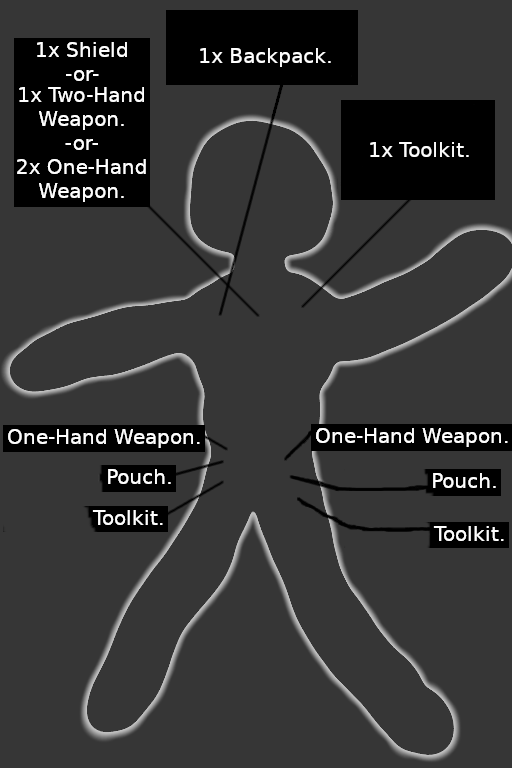
    Each character has several available slots for carrying items:
    • Right hip [1h-weapon], Right hip [Toolkit], & Right hip [misc or ammo]
    • Left hip [1h-weapon], Left hip [Toolkit], & Left hip [misc or ammo]
    • Back [2h-weapon -or- 1h-weapon x2 -or- shield], Back [Toolkit], & Back [misc or ammo]

    Each character may have 1 item assigned to each slot listed. Only items listed in weapon slots may be drawn in combat & may be swapped between at any time. Only ammunition stored in a “[Item specific] container” worn in a carry slot may be retrieved without an action penalty (or add 1 additional non-contested action to retrieve it). Each weapon’s Tier value worn in these slots must be at a level that is equippable by the character (you cannot carry a T12 1h-melee with only Body: 6).

    For example: a character may have a sword, a toolkit, & arrow quiver (as [Item Specific] Pouch) on their right hip -and- a 1h-crossbow, a toolkit, & a bolt pouch (as [Item Specific] Pouch) on their left hip -and- a bow, toolkit, & misc-pack (as Backpack) on their back.

    *Characters may also be allowed to travel with items carried (or equipped) in their hands in addition to their carry slots if allowed by GM, on a case by case basis.

    *Characters cannot wield weapons or shields while actively working on any task(skill) that requires tools.

    Weapons can be stored as loose inventory in backpacks or carts (their size categories are listed right below), but cannot be quickly equipped from anywhere other than their designated worn quick-draw slot. Since weapons being stored this way is not strictly bound to any specific size (only rough categories), & because weapons can vary greatly in size in real life, work with your GM to determine the exact size of your stored weapons or use the highest amount of spaces listed for it’s category.

    Item Size Categories

    Items will be generally categorized as follows:
    • Extra-Small (XS): up to 10 may be stacked in 1 inventory space
    • Small (S): takes up 1 inventory space
    • Medium (M): takes up to 10 inventory spaces
    • Large (L): takes up to 100 inventory spaces
    • Extra-Large (XL): takes up to 1,000 inventory spaces

    (XS) items include coins, 1hr candles, pens, paper, ores, cloth fragments, gems, jewelry, feathers, seeds, healing baubles, & most other very small objects that a person could hold several of in the palm of their hand.

    (S) items include ingots, cloth, 1 day of food, vial of ink, arrows, crossbow bolts, & most small objects that don’t make sense to stack.

    (M) items include books, some pouches designed for carrying on a hip, clothing sets, Lamps, torches, tinderboxes, lumber, rope (10ft), cloaks, 1-Handed weapons, & many other objects that generally use about the same space as a human skull.

    (L) items include most backpacks, most toolkits, stone blocks, 2-Handed Melee weapons, shields, bows, 2-Handed crossbows, tents, bedrolls, armor sets, & most other objects between the size of a human skull & a human skeleton.

    (XL) items include wood beams, Chests, people, & most things larger than a human & smaller than a wagon.

  • General Rules

    Daily Activities

    Each day a player may assign their character to work on 2 “daily tasks”. Generally these tasks would be a production skill, a gathering skill, or travel. A character may mix & match these. ie: you may use Metalworks & Bowyer -or- Metalworks & travel in a day.

    Each task assumes a 5 hours dedicated to it.

    The reason these tasks are so short, is because the rest of that time is for a character to eat, sleep, chat, & relax. The large remaining window allows for storytelling and roleplaying, without sacrificing your task economy. You can sell your gear in town, talk to your favorite NPC in the pub, perform combat, & visit the shop without setting yourself back in your next crafting project. Sleeping an average of 8 hours & working 10 hours still leaves you with 6 extra hours each day for your character to get the chance to feel like a person.

    Food Expiration

    Unpreserved Food Expires After 1 Week.

    Only the cooking skill & magic may extend this time window.

    All creatures with Mind less than 1 can eat spoiled food for an additional week after it has spoiled. No creatures with Mind less than 1 can gain any skills or create fire. All creatures can improvise shelter where it makes sense — such as a cavern.

    it is intended that monster races may hunt for food using either the trapping target number or hunting target number in any zone for food collection (without skills, they only get their presence stat for the modifier).

    Water

    For the time being: For each day of food, we can assume there is also an equal number of days of water.

    Advanced Skill

    Advanced Skills may not be taken until a character has all prerequisite skills at the level listed under that adv skill (or higher).

    You may not use any adv skill until you have at least 1 level in that adv skill.

    The Game-Board Doesn’t Matter

    The rules are written with square tiles — like a chess board. The game was tested on square & hexagonal game-boards — both worked equally well. If you & your group wish, it can even be played without any game-board at all. All you really need is a d20, a few pieces of paper, a writing utensil, & imagination. A tile is equal to 5 feet by 5 feet, or roughly 1.5 meter by 1.5 meter.

  • Creature Size Modifiers

    General Size Categories

    The sizes of races are generally in 4 categories:
    • Small (Sm)
    • Medium (Med)
    • Large (Lg)
    • Extra-Large (XL)

    Generally, the space taken up by the creature is as follows:
    • A small race takes up less than 1 tile (approx: 0.5 tile).
    • A medium race takes up exactly 1 tile.
    • A large race is anything from 2-6 tiles in total size. They have a general size of 4 tiles.
    • A extra-large race is anything greater than 6 tiles in size. They have a general size of 9 total tiles.

    *It should be noted that these sizes are based on battle scenarios. Not based on squeezing through doorways or packing them into a room like sardines. The creature’s footprint (in tiles) only represents the space they occupy when fighting. Useful information for blocking a doorway, or determining the spatial area around them they control for attacking without having to use a movement action.

    Creature Size & Food

    The daily food needed for a creature will be their size in total tiles as:

    • Small creatures are half a tile & need 0.5 of a unit of food each day.
    • Medium creatures are exactly 1 tile & need 1 unit of food each day.
    • 1×2 creatures need 2 units of food each day.
    • 2×2 creatures need 4 units of food each day.
    • 2×3 creatures need 6 units of food each day.
    • 3×3 creatures need 9 units of food each day.
    • 3×4 creatures need 12 units of food each day.
    • 4×4 creatures need 16 units of food each day.

    *A unit of food is often denoted as a “day of food” or as “food/day”, & is a unit based on a human sized portion.

    Creature Size & Inventory Slots

    The number of inventory slots available in containers (pouches, packs, quivers, etc) will be tied to the creature’s general size category as:
    • A small race will have containers that can hold half (0.5x) the normal amount.
    • A medium race will have containers hold a normal (1x) amount.
    • A large race will have containers hold four times (4x) the normal amount.
    • A extra-large race will have containers hold nine times (9x) the normal amount.

    *This is true for all creatures that are within that size category. Even the weird sized creatures.

    Creature Size & Material Costs

    The material cost of all gear including clothing, weapons, armor, tool kits, pouches, etc. will be tied to the creature’s general size category as:

    • A small race will need half (0.5x) the materials.
    • A medium race will need a normal amount (1x) of materials.
    • A large race will need four times (4x) the materials.
    • A extra-large race will need nine times (9x) the materials.

    *Most shops will have costs that reflect this, using these multipliers for the cost in coinage.

    Creature Size & Cooking

    The Cooking Skill Preservation outputs are also tied to a creatures size category as:

    • Small races will half-production (0.5x).
    • Medium is normal (1x).
    • Large produces four times (4x).
    • Extra-large races can cook & preserve nine times (9x).

    *This may result in the cook for many large, distant, forts to be headed by a large race with a full kitchen.

    Creature Size Realism

    Most inns in the world will not accommodate large & extra-large races. If you’re lucky, you might be able to rent a portion of their barn. Most ships in the world will not accommodate them either. They might set up space in the cargo hold. But if they do, they would likely request compensation that is at least as much as the profits they would forego from cargo that would otherwise be transported within that space. The rare places that have rooms large enough to accommodate large & extra-large races usually charge a premium for the space. Usually splitting the large room at discount for several medium races as a “common room” sleeping area.

    Small Creatures

    Small creatures are physically weaker…

    • Small races have five (5) less base Hit Points. Granting them 15 instead of the normal 20 at game start.

    • Small races deal five (5) less damage (calculated after hit checks & before armor reductions) with all melee weapons & thrown weapons.

    Small races may occupy the same tile as 1 other creature, friend or foe. If that creature is 4 tiles big, one small creature may be on each of those tiles. If another creature is a small or medium sized creature, one small creature may share that tile with them. A large creature may also choose to share a tile occupied with by small creature. Medium and larger creatures may not share tiles with each other.

    When a small creature is sharing a tile with an ally:

    • If either creature has a shield, they both get the bonus. Even from rear attacks. If both creatures have a shield, use the shield with the highest armor bonus.

    • If any attack (contested or non-contested) is made on the small creature, it is also done to the other. Non-contested attacks, such as from crossbows, still automatically hit… both of them. If dice are rolled for the action, the person making the contested action against them rolls once & adds up their totals. Then both occupants of that tile roll & add up their totals. Then damage is calculated based on the roll difference of both occupants vs that single roll against them. The individual character’s armor bonus is removed from the damage dealt as normal (apply shield sharing rule if applicable). If the small creature & their ally both win the contested roll, both deal damage to the character that made the initial contested action, if applicable, & in a normal fashion.

    • If any stealth roll is performed against either creature, both may roll against that stealth roll. The stealth check is still one die roll (plus any bonuses). It is compared to both the creature’s roll totals that occupy that tile. If either win the stealth roll, they may intercept the free attack. If they do, treat the free attack as a normal contested attack roll versus only the creature intercepting it. If the creature intercepting the attack does not have a shield equipped, they may not use the shield bonus from the other creature sharing their tile. If both fail, the character that won the stealth roll gains the “stealth attack bonus” against them. They may target either the large creature on that tile or both creatures. If the small creature is the target, the stealth damage from one attack roll is applied to both creatures on the tile. If both creatures succeed in winning the stealth check, the stealth roll fails & no attack occurs.

    When a small creature is sharing a tile with a foe:

    • For the purposes of shields & stealth attacks – occupying the same tile & declaring a contested or non-contested attack toward a creature that is in any size category bigger than the small creature will be treated the same as an attack from the rear. Small versus small combat is treated as though they are on adjacent tiles when they share a tile & combat each other.

    • If any attack (contested or non-contested) is made on the small creature, it is also done to the other! Medium, Large, & Extra Large creatures each risk hitting themselves with any attack on a small creature when occupying the same tile as them. After the attack action is declared, the roll total of the larger creature is added together, then that number is compared to the roll total of both occupants of the tile. This includes the attacking creature itself if they remain on that tile as they declare the attack. They would then have to add up a second roll total for defense to their own attack. If the attack is from a creature on another tile, they might damage their ally sharing that tile with the small creature – the roll difference decides their fate. If the defending character wins a roll against their ally, they may choose to not deal damage in retaliation.

    *This effect is ignored when small creatures attack other creatures of any size that are sharing a tile.
    *If a character hits themselves, they ignore armor bonuses granted from shields.

    Medium Creatures

    Medium creatures are the baseline of all the rules as written. They are the most common size.
    • Medium races have a base Hit Points of 20.
    • Medium races all deal normal damage.

    Large Creatures

    Large creatures are physically stronger…

    • Large races have three (3) more base Hit Points for each tile they occupy in size. Granting them 32 instead of the normal 20 at game start for a 2×2 creature, & 38 instead of 20 for a 3×2 sized creature.

    • Large races deal three (3) extra damage with all melee weapons & thrown weapons for each tile they occupy in size. This is 12 extra damage for a 2×2, & 18 extra damage for a 3×2.

    • Large races have a normal range with all weapons plus 1. Including 1h & 2h melee, projectile weapons, unarmed, etc.

    Extra-Large Creatures

    Extra Large creatures are terrifying…

    • Extra Large races have three (3) more base Hit Points for each tile they occupy in size. Granting them 47 instead of the normal 20 at game start for a 3×3 creature, & 56 instead of 20 for a 3×4 sized creature… & 95 base HP if they are 5×5.

    • Extra Large races deal three (3) extra damage with all melee weapons & thrown weapons for each tile they occupy in size. Dealing an extra 27 damage at 3×3, & 36 extra damage at a size of 3×4… & 75 extra damage if they are 5×5.

    • Extra Large races have a normal range with all weapons plus 2. Including 1h & 2h melee, projectile weapons, unarmed, etc.

    • Extra Large races may have siege weapons mounted on them. They may carry, move, & if they have the required skills, operate them without the aid of others. If they do, it requires an empty 2h weapon/shield carry slot on their back to do so. They may ignore normal Body stat requirements to do so. Instead, they use their Body stat as their limiter for the Tier value of the siege weapon carried similar to other weapons. So that: a Tier 1 Siege weapon requires Body: 1, & a Tier 10 Siege weapon requires Body: 10, etc.

  • Stats & Progression

    Main Stats

    The main stats in the game are Body, Mind, Reflexes, Presence, & Aura.

    *No stat may be a negative number.
    *Average level stats are 5-6 for a professional.
    *Levels 9-10 are usually reserved for the best in their field.
    *Levels 11-12 are legendary, & usually reserved for only player characters or “power NPC’s”.
    *Levels higher than 12 are restricted to only a few races.

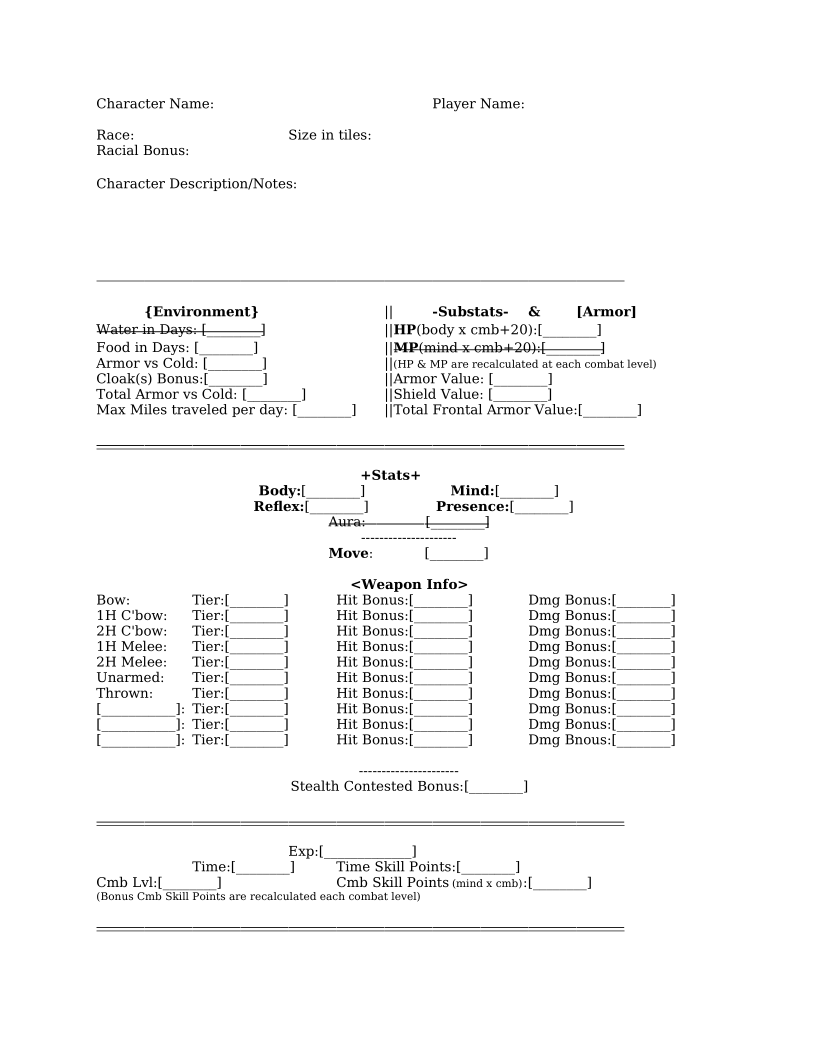
    Body – Determines weight lifted & carried, Tier of gear that can be equipped, Total HP as [HP= (Body x Combat Level)+ 20], Bonus Damage for most combat skills, distance walked/ran, & HP recovery as: [Body stat value] in HP each day.

    While on a trail a character may travel a maximum their races “Move” value plus their Body stat in miles per day while walking [Daily Miles= Body + Move]. Generally, traveling off road or off trail will be considered half speed [Daily Miles= (Body+ Move) /2]. This number may be further reduced due to terrain declarations made by GM for any number of reasons.

    Mind – Determines the maximum skill level that can be obtained through passive learning (each month, each player character gains 1 time skill point), Total MP as [MP= (Mind x Combat Level)+ 20], & bonus skills gained at combat level as: [Mind stat value] x [Combat Level] in Cmb skill points.

    Reflexes – (Commonly Rflx) Determines dice modifiers applied to most combat skills on a 1:1 basis.

    Presence – (Commonly Prs) Determines dice modifiers applied to most non-combat contested rolls for skills on a 1:1 basis.

    Aura – Not used at this time.

    Sub-Stats

    Sub-Stats are effected by the relationship between a character’s current combat level & current values in their main stats (Body & Mind).

    HP – or Hit Points – Determines the amount of damage that a character can receive from environment or combat before losing consciousness or dying. Unconsciousness occurs whenever a character’s HP becomes 0 or lower. Death occurs when a character reaches their HP total in negative numbers (a character with 20HP total will be out of combat at 0HP & dead at -20HP)

    MP – Not used at this time.

    Combat Level – (Commonly Cmb or Cmb Level) – A character starts at Combat Level 1, & for every 2,000 exp gained they add another Combat Level. For each Combat Level gained, they will gain 1 bonus Stat point to put into their main stats & extra HP/MP & bonus skill points based on their Mind stat.

    Experience – (Commonly Exp) – is a reward given to characters by GM for doing epic things or beating up other things.

  • Character Creation

    A character starts at Combat Level 1. Starting exp is 0.

    Upon character creation, a player may assign 25 points to their Stats however they choose. Provided they do not assign more than 10 points into any one stat.

    Upon character creation, after stats are distributed, a character will gain 2 years of passive learning (aka “Time Skill points”). This amounts to 24 skill points that may be distributed.

    At Creation & Through Progression

    Skill points from Time may not be higher than the Mind stat in any skill.

    Upon character creation & at each Combat Level, a character will have their HP updated to reflect [(Body x Combat Level)+ 20HP]. Gaining additional points in Body stat will greatly influence HP at later Combat Levels because of this.

    Upon character creation & at each Combat Level, a character will gain 1 skill point for each level in their Mind stat (reflected as: Mind x Combat Level). These skill points may exceed the Mind stat & are added to the learned skill points (aka “Cmb Skill points”) to determine the total skill level.

    Broken Content

    MP is not used at this time.

    Aura stat is not used at this time.

    Magic skills & spells are not available at this time.

    Choose a Race

    See- “Playable Races” for details

    Purchase Gear

    For full disclosure: currently there is only a limited item shop available. Most items must be created through gameplay. Items that cannot be created must be discovered through adventures or purchased in shops, all at the whims of your gracious GM. There is no standard yet for starting cash. This game is still in alpha testing, & is getting more content added by popular demand.